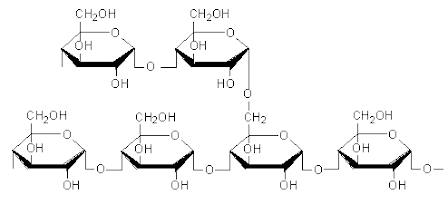
Amylopectin is one of the biggest molecules in nature being the principal component in the majority of starches. Starches with varying amylose and amylopectin content are of particular interest due to their ability to influence and modify the texture, quality and stability of starch-based food products.
Starch normally contains about 20–30% amylose and 70–80% amylopectin. Amylopectin consists of numerous chains that are much shorter than the major chains found in amyloses.The branched amylopectin molecule contains regions with low and high levels of branches. The branches in amylopectin constitute about 5% of the molecule, which results in a very complex molecular structure. Short chains of amylopectin form double-helices, which crystalize and contribute to the semi-crystalline nature of the starch granules.
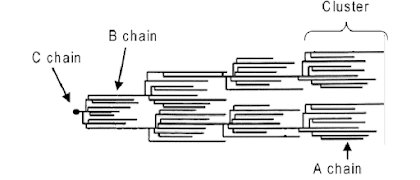
In highly branched regions, side-chains of amylopectin are grouped, forming crystalline zones (clusters). Side chains of the amylopectin molecule can be divided in A, B, and C chains. The A chains are the shortest.
C chains constitute the backbones of the amylopectin molecules, to which B-chains are linked that at the same time carry one or more branches. The B chains are classified into B1, B2, B3 and B4 depending on their length and the number of clusters that they span.
Amylopectin
Nutrition is a scientific discipline that encompasses a structured body of knowledge. It includes various fields such as clinical nutrition, community nutrition, public health, food policy, and food science. At its core, nutrition is the study of how the body utilizes food. It is essential to life. Understanding nutrition enables us to make better dietary choices by determining the necessary nutrient intake, identifying optimal food sources, and recognizing beneficial or harmful food components.
Showing posts with label starch. Show all posts
Saturday, January 22, 2022
Saturday, July 03, 2021
Starch component: Amylose
Starch is one of the biggest components of carbohydrates in food and other biological materials. The most important sources for humans are diverse cereals, rhizomes, roots and tubers. It can exist in two forms, amylose and amylopectin, both of which are polymers of D-glucose.
The amylose molecule is a linear, unbranched structure in which the glucose residues are attached solely through α-1,4 glycosidic bonds.
The amylose, in an aliquot of the supernatant, is enzymically hydrolyzed to D-glucose, which is analyzed using glucose oxidase/peroxidase reagent.
Amylose chains are helical with hydrophobic, lipophilic interiors capable of forming complexes with linear hydrophobic portions of molecules that can fit within the lumen of the helix.
The molecular weight range of amylose (i.e., 80000–1000000) is quite broad and varies in between plant species, varieties and maturity of the starch under study. Amylose can be considered as a linear polymer, but nevertheless contains a very low number of α-1,6 branching points (less than 1.0%).
It was reported that starchy foods with high amylose levels are associated with lower blood glucose levels and slower emptying of the human gastrointestinal tract compared to those with low levels of this macromolecule.
Starch component: Amylose
The amylose molecule is a linear, unbranched structure in which the glucose residues are attached solely through α-1,4 glycosidic bonds.
The amylose, in an aliquot of the supernatant, is enzymically hydrolyzed to D-glucose, which is analyzed using glucose oxidase/peroxidase reagent.
Amylose chains are helical with hydrophobic, lipophilic interiors capable of forming complexes with linear hydrophobic portions of molecules that can fit within the lumen of the helix.
The molecular weight range of amylose (i.e., 80000–1000000) is quite broad and varies in between plant species, varieties and maturity of the starch under study. Amylose can be considered as a linear polymer, but nevertheless contains a very low number of α-1,6 branching points (less than 1.0%).
It was reported that starchy foods with high amylose levels are associated with lower blood glucose levels and slower emptying of the human gastrointestinal tract compared to those with low levels of this macromolecule.
Starch component: Amylose
Sunday, March 10, 2019
Starch in food
Plants use water, carbon dioxide and energy from the sun to form simple
sugars through a process called photosynthesis. When the sugar chains
gather in large quantities inside a plant’s cells, they form starch
grains, also called starch granules.
Starch is deposited in granules in almost all green plant and in various types of plant tissues and organs, e.g leaves, roots, shoots, fruits, grains and stems.
Grains are the riches food source of starch, providing much of the food energy for people all over the world. Starch may be produced from potatoes, rice, tapioca, or wheat by methods similar to corn, except that with potatoes and tapioca it is not necessary to degerm the product.
Starch is valuables because it can break down into simple sugars that
provide human with sustained energy and keep them feeling full and
satisfied.
Starch in food
Starch is deposited in granules in almost all green plant and in various types of plant tissues and organs, e.g leaves, roots, shoots, fruits, grains and stems.
Grains are the riches food source of starch, providing much of the food energy for people all over the world. Starch may be produced from potatoes, rice, tapioca, or wheat by methods similar to corn, except that with potatoes and tapioca it is not necessary to degerm the product.
Starch in food
Wednesday, April 12, 2017
Carbohydrates content in rice
As a food material rice is nutritious and easily digestible. In comparison with other grains it is poor in nitrogenous material and fat, and correspondingly rich in non-nitrogenous substances or carbohydrates.
Cleaned rice contains 79% carbohydrate. Carbohydrate of rice is predominantly starch, with small portions of pentosans, hemicelluloses and sugars. As in most starches, both of the major components (amylase and amylopectin) occur generally in rice starch.
Sugars comprise some 0.3 to 0.5% of white rice and about 0.6 to 1.4%b of brown rice. Reducing sugars (maltose) increase and non-reducing sugars (sucrose) decrease during storage. The degradation of carbohydrates to CO2 is usually very small, but it may become significant at moisture more than 14%.
The changes of free carbohydrate content are greatly influenced by temperature. Maillard’s browning reaction between free carbohydrates and free amino acids may play a significant role in CO2 formation.
Fiber is a carbohydrate and is also a carbohydrate blocker. In other words, it slows down the absorption of digestible carbohydrates.
Carbohydrates content in rice
Cleaned rice contains 79% carbohydrate. Carbohydrate of rice is predominantly starch, with small portions of pentosans, hemicelluloses and sugars. As in most starches, both of the major components (amylase and amylopectin) occur generally in rice starch.
Sugars comprise some 0.3 to 0.5% of white rice and about 0.6 to 1.4%b of brown rice. Reducing sugars (maltose) increase and non-reducing sugars (sucrose) decrease during storage. The degradation of carbohydrates to CO2 is usually very small, but it may become significant at moisture more than 14%.
The changes of free carbohydrate content are greatly influenced by temperature. Maillard’s browning reaction between free carbohydrates and free amino acids may play a significant role in CO2 formation.
Fiber is a carbohydrate and is also a carbohydrate blocker. In other words, it slows down the absorption of digestible carbohydrates.
Carbohydrates content in rice
Saturday, August 11, 2012
Starches in food
Plant cells store glucose as starches – long branches or unbranched chains of hundreds or thousands of glucose molecules linked together.
It is a plant polysaccharide stored in roots and seeds of plants and is in the endosperm of a grain kernel. It provides humans with energy 4 cal per gram and is hydrolyzed to glucose.
It occurs in the form of granules, which are usually an irregular rounded shape, ranging in size from 2 to 100um. Both the shapes and sizes of the granules are characteristics of the species of plant and can help to identify the origin of a starch or flour.
Starch from plants is used to produce various foods such as bread and pasta. Many vegetables such as corn and potatoes also contain starch.
Starch is made up to two molecules, amylose and amylopectin, whose parts are connected by glycosidic linkages. Amylose molecules typically make up approximately one-quarter of starch.
Most starches have 20-25% amylose. However, pea starch is 60% amylose.
In foods products, modified starch thickens readymade sauces; adds a sheen to cake frostings, jelly beans and wine gums; and improves the texture, or ‘mouth feel’, of puddings, pie fillings and even baby foods.
It is a plant polysaccharide stored in roots and seeds of plants and is in the endosperm of a grain kernel. It provides humans with energy 4 cal per gram and is hydrolyzed to glucose.
It occurs in the form of granules, which are usually an irregular rounded shape, ranging in size from 2 to 100um. Both the shapes and sizes of the granules are characteristics of the species of plant and can help to identify the origin of a starch or flour.
Starch from plants is used to produce various foods such as bread and pasta. Many vegetables such as corn and potatoes also contain starch.
Starch is made up to two molecules, amylose and amylopectin, whose parts are connected by glycosidic linkages. Amylose molecules typically make up approximately one-quarter of starch.
Most starches have 20-25% amylose. However, pea starch is 60% amylose.
In foods products, modified starch thickens readymade sauces; adds a sheen to cake frostings, jelly beans and wine gums; and improves the texture, or ‘mouth feel’, of puddings, pie fillings and even baby foods.
Starches in food
Sunday, January 30, 2011
Starch in Human Nutrition
Starch is a widely distributed and abundant constituent of vegetable tissue.
Starch are by far the most significant polysaccharide in the diet. They are are found in grains, legumes and other vegetables and some fruits in minute amounts.
In human nutrition, starch is by far the most significant polysaccharide. It is a relatively large complex compound made up of many coiled or branching chains of single glucose unit.
It yield only glucose in digestion.
After cooking starch is highly digestible by human beings, raw starch often resists digestion.
Many cooks use starch for such diverse properties as thickening gravies and soups, making a sweet pudding or dusting pastry before cooking.
The major food sources of starch include grains in the form of cereal, pasta, crackers, bread and other baked goods.
Starch is used to produce food extenders and sugars syrups such as maltodextrins, glucose, dextrose, fructose, maltose and hydrogenated derivatives.
The extent of starch breakdown within the small intestine varies, depending on the physical form of the food, therefore a substantial amount of the total starch, called ‘resistant starch’ can escape digestion in the small intestine and enter colon.
Starch in Human Nutrition
Starch are by far the most significant polysaccharide in the diet. They are are found in grains, legumes and other vegetables and some fruits in minute amounts.
In human nutrition, starch is by far the most significant polysaccharide. It is a relatively large complex compound made up of many coiled or branching chains of single glucose unit.
It yield only glucose in digestion.
After cooking starch is highly digestible by human beings, raw starch often resists digestion.
Many cooks use starch for such diverse properties as thickening gravies and soups, making a sweet pudding or dusting pastry before cooking.
The major food sources of starch include grains in the form of cereal, pasta, crackers, bread and other baked goods.
Starch is used to produce food extenders and sugars syrups such as maltodextrins, glucose, dextrose, fructose, maltose and hydrogenated derivatives.
The extent of starch breakdown within the small intestine varies, depending on the physical form of the food, therefore a substantial amount of the total starch, called ‘resistant starch’ can escape digestion in the small intestine and enter colon.
Starch in Human Nutrition
Saturday, May 03, 2008
Definitions for Polysaccharides
Definitions for PolysaccharidesPolysaccharides are complex polymers containing only one monosaccharide, homopolysaccharides, or several different monosaccharides or monosaccharide derivatives, heteropolysaccharides. Many polysaccharides exist in the plant and animal kingdoms. However, only a few of these are known to be significant in mammalian nutrition, either as dietary constituents or as human cell metabolites.
The most common digestible polysaccharides in plants is starch, a polymer of glucose. Starch is present primarily in the cells of grains, fruits and tubers in the form of granules that, under microscopes examinations, appear to be typical for each starch. The composition of starches also differs somewhat, but all types contain both amylase, a straight chain polymer of glucoses, and amylopectin, a branch chain polymer. The average chain contains 20 to 25 glucose units with approximately 5 to 8 glucose molecules between branching points within the chain. On hydrolysis in the intestinal tract, starch yields dextrin and maltose and, eventually glucose.
Definitions for Polysaccharides
Monday, December 24, 2007
Carbohydrates
Carbohydrates
Carbohydrates are defined as polyhydroxy aldehydes and ketones and their derivatives and vary from simple three-carbon sugars to complex polymers. Most carbohydrates conform tot the general formula (CH2O)n, but the classification of carbohydrates includes compounds that are not true hydrates as the names implies.
For example, deoxyribose contains 5 carbon atoms, 10 hydrogens, but only 4 oxygen rather than 5 as is customary for pentose. Moreover, some compounds that are properly classified as carbohydrates in terms of chemical properties contain nitrogen or sulfur addition to carbon, hydrogen, and oxygen.
Carbohydrates are classified into three main groups, monosaccharide, or simple sugars; oligosaccharides, of which the most prevalent in nature are the disaccharides; and polysaccharides the most complex of the carbohydrates.
Starch is by far the most important source of carbohydrates in the human diet amounting to approximately 50% of total carbohydrate in the United States, but often as much as 75% total carbohydrates in some of the developing countries.
Sucrose ranks next in important comprising about 25% of carbohydrates intake. In the last 70 years the intake of complex carbohydrates in the diet of United States has decreased, and the intake of sucrose has markedly increased.
Carbohydrates

Carbohydrates are defined as polyhydroxy aldehydes and ketones and their derivatives and vary from simple three-carbon sugars to complex polymers. Most carbohydrates conform tot the general formula (CH2O)n, but the classification of carbohydrates includes compounds that are not true hydrates as the names implies.
For example, deoxyribose contains 5 carbon atoms, 10 hydrogens, but only 4 oxygen rather than 5 as is customary for pentose. Moreover, some compounds that are properly classified as carbohydrates in terms of chemical properties contain nitrogen or sulfur addition to carbon, hydrogen, and oxygen.
Carbohydrates are classified into three main groups, monosaccharide, or simple sugars; oligosaccharides, of which the most prevalent in nature are the disaccharides; and polysaccharides the most complex of the carbohydrates.
Starch is by far the most important source of carbohydrates in the human diet amounting to approximately 50% of total carbohydrate in the United States, but often as much as 75% total carbohydrates in some of the developing countries.
Sucrose ranks next in important comprising about 25% of carbohydrates intake. In the last 70 years the intake of complex carbohydrates in the diet of United States has decreased, and the intake of sucrose has markedly increased.
Carbohydrates
Saturday, February 03, 2007
The Starch
The Starch
The commonest digestible polysaccharide in plants is starch, and it can exist in two forms, amylose and amylopectin, both of which are polymers of D-glucose.
The amylose molecule is a linear, unbranched structure in which the glucose residues are attached solely through a-1,4 glycosidic bonds.
Amylopectin, on the a other hand, is a branched-chain polymer, the branch points occurring through a-1,6 glycosidic bonds.
The Starch
The commonest digestible polysaccharide in plants is starch, and it can exist in two forms, amylose and amylopectin, both of which are polymers of D-glucose.
The amylose molecule is a linear, unbranched structure in which the glucose residues are attached solely through a-1,4 glycosidic bonds.
Amylopectin, on the a other hand, is a branched-chain polymer, the branch points occurring through a-1,6 glycosidic bonds.
The Starch
Subscribe to:
Posts (Atom)
Popular articles
-
Plant foods are the main dietary sources of selenium worldwide, but their selenium content depends largely on the soil in which they are gro...
-
Saturated fatty acids do no not contain any double bonds of other functional groups along the chain. The term ‘saturated’ refers to hydrog...
-
Cholesterol and triglycerides are fats and are insoluble in the blood. However, when they combine with protein they became lipoproteins and...
-
Rice contributes to the major dietary energy for body. It is a main carbohydrate source in many Asian countries. It provides 23 per cent mor...
-
Chikuwa is one of Japan’s most recognizable fish cakes, valued for its unique tube shape, mild flavor, and versatility in everyday cooking. ...